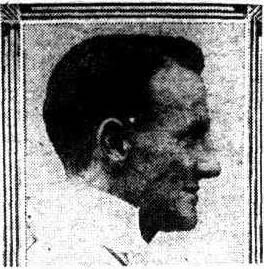
James "Judy" Masters
James William Masters was born on 21st May 1892 at Balgownie, NSW, the 7th of thirteen
children of Alexander Masters, a miner from Nova Scotia, Canada and his Sydney born wife
Francis Eliza. James attended Balgownie Public School where football dominated the playground.
He captained his school team and and at age 12 joined the local Balgownie club. By the age of
15 he was playing 1st grade football for Balgownie before joining Sydney clubs Newtown in 1913, and Granville in 1914. It was around this time he began working at the Clyde Engineering
Company.
Soon, like many other young men, his life would be changed forever when the Great War called.
He enlisted in the Australian Imperial Force and began training at the Liverpool Camp on 1st
June 1915 before heading to Gallipolli and then the Western Front. He was wounded at
Pozieres in 1916, promoted to Sgt in 1918, and returned to Australia for discharge in 1919.
While on leave in England, he had met Anne Barraclough, and they were later married at
St Michael's Anglican church, Wollongong in 1920. They soon set up home in Balgownie,
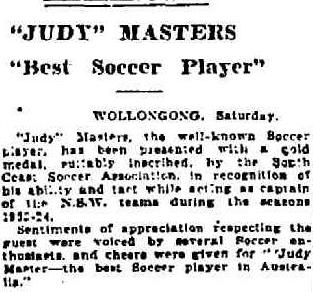
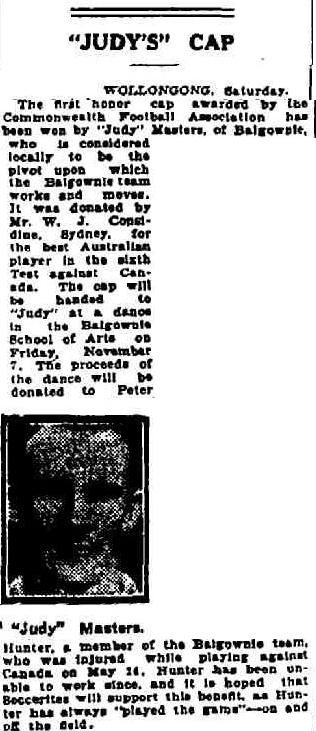
just 100 yards from the club's home ground. Masters, who captained Balgownie, the South
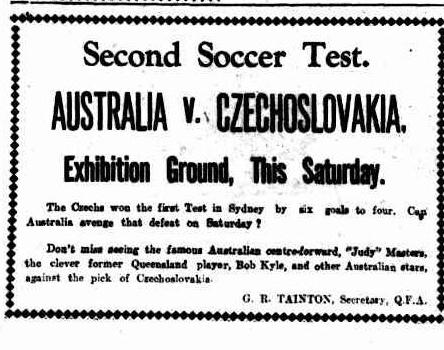
Coast Rep side, New South Wales and Australia, was to become the highest profile player
of the time.
At 5ft 7in, 10 stone, and with his body hardened through shifts in the Mount Pleasant coalmine, football training and a daily regime of evening runs, he was known as 'bones and muscle'.
But it all could have been so different. In December 1923, a rock fall at work nearly killed him.
He suffered a fractured skull, a broken jaw and severe bruising over his body. He was taken
to the local hospital and listed as critical. Thankfully by mid 1924 he was back playing.
After decent performances in 1924, many commentators believed Australia had a chance
of defeating the crack English side when they toured the following year and that Masters
was the key. A.J.B. writing in the Sydney newspaper The Arrow, suggested that Masters'
performances would "find himself a Rexona beauty in the morning and teams all over
Europe would be cabling asking our terms for a tour."
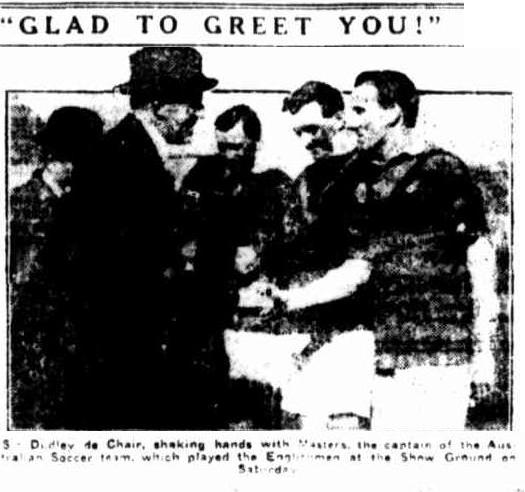
Masters' first game against the tourists took place on May 30th at Sydney Showground
when he captained the NSW team.
In a pre-game interview Masters declared - "The Englishmen must be great players to win all
their matches to date but they will need to step it tomorrow. Our boys will be very fit and all
are keen as razor blades."
Things started well for NSW, in particular Masters. The English side kicked off, but were soon
robbed of the ball. It was played quickly forward, and Masters was on hand to head home to give
NSW an amazing 1st minute lead. England equalised but soon knew they were in for their
first real fight of the tour when Masters gave NSW a 2-1 lead. NSW would eventually lose
3-2, but Masters had made a definite impression with UK newspapers later describing him
equipped with "quick thinking, first time shot."
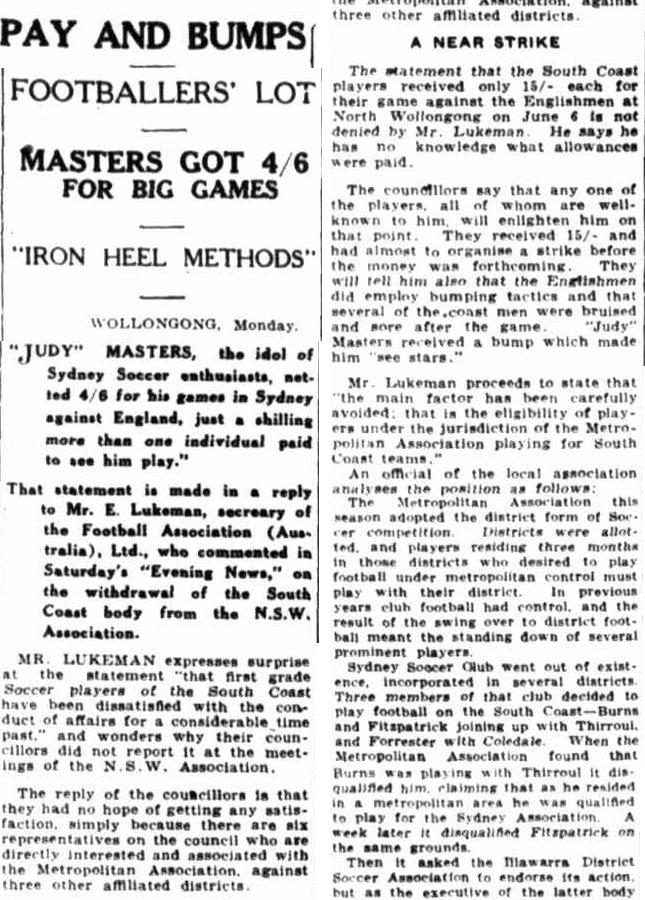
On June 6, at Wollongong, the South Coast team, captained by Masters, refused to take to
the field unless they were paid. At that time, only expenses were given to the local players
whereas the touring English team were receiving 1600 pounds a match. Eventually the
Association agreed to pay 15/ per game, the equivalent to 3 hours working in a mine.
This did little to quell a long simmering dispute between the NSW Association and the
South Coast Association.
The Illawarra Association began to air dirty laundry via the newspapers, stating that they
were "disgusted" with the treatment of their players who had been selected to play for NSW.
They had travelled as a group to Sydney and upon arrival waited 90 minutes for any NSW
Association member to make contact. After the game, Masters had to wait so long to
get his match payment of 1 pound (out of gate takings circa 2200 pounds) that he had
to catch a taxi so that he did not miss his 6.30pm train ride home.
Subsequently, on June 15, the Illawarra Association withdrew their support of their Sydney
counterparts, effectively banning any South Coast player from being selected to represent
NSW or Australia.
As a result Masters did not play in the 1st two tests against England. It would take nearly a
month, but eventually the NSW Association, without their star player, relented and agree to pay
a back dated 'honorarium' to each player that had played in each test match.
Masters continued to dominate the centre-forward position in Australian football for the next few
years, and captained Australia against the touring Chinese and Yugoslavian (Hajduk Split)
teams in 1927.
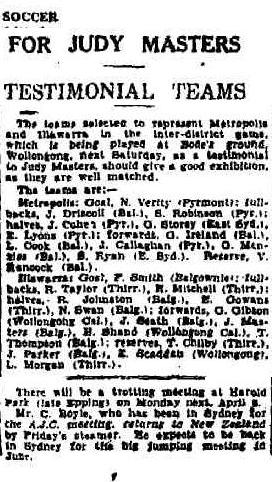
A testimonial game was held on 6th April 1929 between Illawarra and Sydney Metropolis with
Illawarra running out easy winners, 11-2. Masters scored 4 goals, and over 30 pounds was
collected pre-game. He eventually received a cheque for 50 pounds and finally retired at
the end of the 1931 season, age 39.
He would continue to be involved with his beloved Balgownie either as a coach or committee
man. At the age of 49 years and 11 months, Masters once again signed up to the Australian
Military Forces, however his services were not required, and he was discharged.
James "Judy" Masters passed away in December 1955 from symptoms relating to the Miner's
curse, pneumocniosis.